This high-speed-connection thing is pretty cool. Now I can watch videos on YouTube and see all the things everyone talks about that aren't worth seeing. Sometimes, though, I can see things that amuse the hell out of me, even if they aren't worth seeing.
The video below cracks me up. It's an intentionally bad hip-hop song about George Washington, and I'm not sure which of its targets deserves lampooning more. It pokes fun at American patriotic myth, the worship of the Founding Fathers, with a silly video. It also points out the stupidity of rap braggadoccio.
If you don't like crude language, cartoon violence, or sexual absurdity, don't watch this. If you are a well-adjusted adult, feel free to view the insanity.
He's coming. He's coming. He's coming.
Saturday, January 27, 2007

Sunday, January 21, 2007
Stupid White Men by Michael Moore
 I generally avoid books like this, even when I'll likely agree with the politics, because I don't want to contribute to the shrill, closed-minded barking that passes for political discourse anymore. But I tried this book for two reasons: one is that I'm capable of analyzing the material and teasing out what's substance and what's noise, and the second is that it was on the bargain table for two dollars. I figured, if nothing else, I'd be a bit better informed about how these arguments are made.
Moore takes a lot of flak for his anti-conservative stance, and most of his detractors fall in the Republican camp, so I was a bit surprised to find he's so critical of the Democrats, too. In fact, he sees the two parties as co-conspirators in the political shell game that distracts voters from seeing a clear picture. In short, his political position is almost identical to mine.
This book has some good and some bad. The good is that it raises questions that ought to be examined. The bad is that he uses these issues mostly as launching points for rants and jokes. These are amusing, but don't do much in the way of political discourse. Moore leaves it to the reader to further explore these ideas, and my guess is that those who criticize him most vehemently either see these rants as an effort to close the debate, or they fear the readers will consider this the final word. Either would be a mistake, and I think the critics show a lack of respect for the American reading citizen.
Of course, with the state of the nation as it is, maybe that disrespect is appropriate.
Go ahead and read this if you want some new ways to assess the State of the Union, but don't check your brain at the door. These are just ideas, not answers.
Friday, January 19, 2007
Reflections in a Golden Eye by Carson McCullers
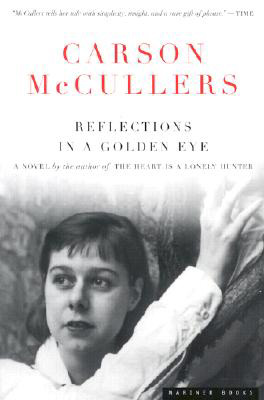
How have I not read Carson McCullers before? Just a few pages into this book I knew I liked it a lot. Maybe it's the setting: a military base in the South. Or maybe it's the first character McCullers introduces: Private Elgee Williams, a large, quiet loner who wanders around the base lost in his head. Or, maybe it's McCullers's sleek, spare prose, her sharp selection of detail, and her ability to nail a character description in one phrase. I feel an affinity for Private Williams because he reminds me of me while I was stationed in Virginia in 1990, but this story grabbed me because it's damn well written.
I know, though, why I've never read McCullers before. Her most famous novel is The Heart is a Lonely Hunter, and anyone who's shared an office or a workshop or the viewing of any television show with me can predict how that title's going to get under my skin. For those who don't already know, here's the scoop:
The sentimental notion that the heart is the center of human emotion is the vilest kitsch-vector on record. At best, it's unreflective and saccharine. At worst, it reflects an effort to imply some sort of difference between emotions and other mental dispositions, usually to advance some kind of pseudo-spiritual fluff about "knowing in your heart" or "A fool says in his heart. . . ."
The heart is a muscle that recieves electrical impulses from the brain for the purposes of circulating blood around the body. That's it. If you have anything other than blood in your heart--and that includes "love" and "joy" and "hope"--see a doctor. You need to have that removed before you have a heart-attack or a stroke.
I feel better now.
Fortunately, Nancy Bombaci's book Freaks in Modern American Culture provoked me to read McCullers. Now I will have to read all of her novels, including The Blood-Pumping Muscle is an Anthropomorphized, Isolated Animal-Killer.
Sunday, January 14, 2007
I Know My Mom Keeps a Lot Locked Up Inside Her, But . . .
After twenty-seven years working in an elementary school cafeteria, most of it as the boss, my mom's retiring in a couple of weeks. Almost three decades dealing with miniature pseudo-humans and all of their dysfunctions, and coping with their sometimes less mature parents, and it's down to nine working days.
Of course, Mom doesn't see it that way. She likes the kids. That's the best part of her job. There have been bad spots, but she also has almost three decades of good kids, the ones who thank her, the ones who give her little gifts and don't whine, and whose parents don't blame her for their failure to PAY FOR THEIR CROTCH-FRUIT'S MEALS. I'm a little more touchy about people being mean to my mom than she is. She thinks of the good things, even if she's uneasy about someone new taking over her kitchen.
She also has a lot of co-workers, past and present, that she'll miss seeing every day. One of those, a fourth-grade teacher, had her class write my mom cards. They were drawn in crayon on white paper, and displayed a range of ability with words and drawing. Even the ones scribbled out like form letters were cute and touching.
I'm not one to make fun of people (quiet . . . ), but sometimes mistakes are made (thank you, Charles Baxter) and they can be funny. One girl wrote a card that included the following:
"Thank you for serving our lunch and Preparing our lunch. Your a great prison."
That made my day. How does a kid spell "preparing" correctly but not "person?" Amazing. And funny.
Of course, Mom doesn't see it that way. She likes the kids. That's the best part of her job. There have been bad spots, but she also has almost three decades of good kids, the ones who thank her, the ones who give her little gifts and don't whine, and whose parents don't blame her for their failure to PAY FOR THEIR CROTCH-FRUIT'S MEALS. I'm a little more touchy about people being mean to my mom than she is. She thinks of the good things, even if she's uneasy about someone new taking over her kitchen.
She also has a lot of co-workers, past and present, that she'll miss seeing every day. One of those, a fourth-grade teacher, had her class write my mom cards. They were drawn in crayon on white paper, and displayed a range of ability with words and drawing. Even the ones scribbled out like form letters were cute and touching.
I'm not one to make fun of people (quiet . . . ), but sometimes mistakes are made (thank you, Charles Baxter) and they can be funny. One girl wrote a card that included the following:
"Thank you for serving our lunch and Preparing our lunch. Your a great prison."
That made my day. How does a kid spell "preparing" correctly but not "person?" Amazing. And funny.
I agree. Mom's a great person. And she 's never locked me up that I can recall. If she has, it's been years. No matter how much I've deserved it.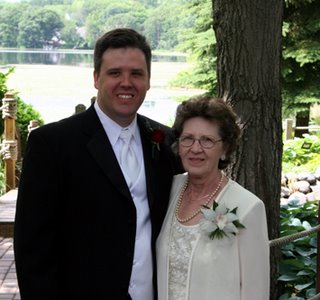
Mom and me on my wedding day.
Congratulations, Mom!
Saturday, January 13, 2007
Martin Luther King, Jr. -- Time For Me To Be Serious (Mostly)
There are few historical figures I hold in high regard. Most who have made themselves notable enough to be recorded in posterity are remembered for their use of violence or trickery to gain power, even when they used that power wisely. Marcus Aurelius left some brilliant aphorisms and seemed to have his heart in the right place, but spent his life waging war. Abraham Lincoln and Thomas Jefferson did great things, but their attitudes and practices in regard to slavery raise questions.
Only a handful stand out as unimpeachable: Socrates, Diogenes of Sinope, Mohandas Gandhi, and MLK.
One of our usual UPS drivers is a short, gregarious white guy I'll call "Biff." Biff is in the Air National Guard in addition for driving the Brown Machine, and he recently spent half a year in Iraq doing Dubya's dirty work. Biff and I get along most of the time, because our brief encounters each day only allow for surface conversation and bantering. The other day he kind of irked me, though.
Just before he left after loading a few pallets on his truck, Biff said, "Are you guys going to be open on Monday?"
One of my co-workers didn't connect the dots, didn't remember that Monday is MLK day. He said, "Why would we be closed?"
Biff smiled like an imp and said, "Monday's James Earl Ray Day."
Over the last three years Biff's been picking up at our dock I've never gotten the impression he's a bigot. Actually, I'd put money on the likelihood he's not, but that kind of offhanded stupidity really frosted my ass that time. In one of those rare moments when the perfect comment occurs to me at the time it's needed I knew how to kick the legs out from under this Chair Force officer, this super-patriot Dubya supporter, this smug knucklehead.
I said, "So by your logic we should be calling September 11 'Al Qaeda Day.'"
The imp-grin slid off Biff's face and he looked at me like--well, like I'd just called him out for being an ass. "I was just trying to be funny," he said.
There was a problem in my logic too, though. A true parallel to my comment would be to call April 4 "James Earl Ray Day," since that's the day he shot King. And really, who's unimpeachable? The evidence suggests King cheated on Coretta, maybe for most of their married lives. Gandhi admits in his own autobiography that he never treated his wife, Kasturbai, very well. Not surprising, since they were married when he was 13 and she was younger. And Diogenes has his detractors (I think it's that whole "masturbating in public" thing). And all we know of Socrates is what Plato (a great admirer) chose to record.
I guess it's enough that King's public works were significant, courageous, and selfless. One might wonder what he'd have to say about the current state of the union, and Colbert I. King has. His column this morning makes a pretty clear case.
Only a handful stand out as unimpeachable: Socrates, Diogenes of Sinope, Mohandas Gandhi, and MLK.
One of our usual UPS drivers is a short, gregarious white guy I'll call "Biff." Biff is in the Air National Guard in addition for driving the Brown Machine, and he recently spent half a year in Iraq doing Dubya's dirty work. Biff and I get along most of the time, because our brief encounters each day only allow for surface conversation and bantering. The other day he kind of irked me, though.
Just before he left after loading a few pallets on his truck, Biff said, "Are you guys going to be open on Monday?"
One of my co-workers didn't connect the dots, didn't remember that Monday is MLK day. He said, "Why would we be closed?"
Biff smiled like an imp and said, "Monday's James Earl Ray Day."
Over the last three years Biff's been picking up at our dock I've never gotten the impression he's a bigot. Actually, I'd put money on the likelihood he's not, but that kind of offhanded stupidity really frosted my ass that time. In one of those rare moments when the perfect comment occurs to me at the time it's needed I knew how to kick the legs out from under this Chair Force officer, this super-patriot Dubya supporter, this smug knucklehead.
I said, "So by your logic we should be calling September 11 'Al Qaeda Day.'"
The imp-grin slid off Biff's face and he looked at me like--well, like I'd just called him out for being an ass. "I was just trying to be funny," he said.
There was a problem in my logic too, though. A true parallel to my comment would be to call April 4 "James Earl Ray Day," since that's the day he shot King. And really, who's unimpeachable? The evidence suggests King cheated on Coretta, maybe for most of their married lives. Gandhi admits in his own autobiography that he never treated his wife, Kasturbai, very well. Not surprising, since they were married when he was 13 and she was younger. And Diogenes has his detractors (I think it's that whole "masturbating in public" thing). And all we know of Socrates is what Plato (a great admirer) chose to record.
I guess it's enough that King's public works were significant, courageous, and selfless. One might wonder what he'd have to say about the current state of the union, and Colbert I. King has. His column this morning makes a pretty clear case.
Thursday, January 11, 2007
Hitler's Big Lie Becomes a Jedi Mind Trick
I hardly know where to begin. Dubya must be trying really hard to keep moving so consistently in the direction opposite the rest of the country. After every decision he's made has blown up in his face he still has the ability to make predictions:
The consequences of failure are clear: Radical Islamic extremists would grow in strength and gain new recruits. They would be in a better position to topple moderate governments, create chaos in the region and use oil revenues to fund their ambitions. Iran would be emboldened in its pursuit of nuclear weapons. Our enemies would have a safe haven from which to plan and launch attacks on the American people.
There are, of course, a few problems here. Such as the sad fact that Dubya's actions have enabled "Radical Islamic extremists" to recruit virtually everybody in the Muslim world. Citizens of our "ally," Saudi Arabia, have been using oil money to fund al Qaeda since its inception. Iran doesn't show any shyness about pursuing nuclear weapons as it is, and those fighting in Iraq seem to be pretty intent on fighting in Iraq. Another Bush attempt to conflate the Disaster in Iraq with the War on Tara (and what did Scarlett O'Hara have to do with all of this, anyway?).
Maybe the real problem is that it doesn't blow up in his face. It blows up in soldiers' faces. And arms, and legs, and heads. This is like fiction to him. There is Good and Evil, and he knows which is which, and how Good will "win." It's fantasy.
Whenever Dubya gives a speech it appears to me like he's using the force to convince the television audience. This:
Whenever Dubya gives a speech it appears to me like he's using the force to convince the television audience. This:
Yet, over time, we can expect to see Iraqi troops chasing down murderers, fewer brazen acts of terror, and growing trust and cooperation from Baghdad's residents.
When this happens, daily life will improve, Iraqis will gain confidence in their leaders, and the government will have the breathing space it needs to make progress in other critical areas.
. . . seems a lot like this: 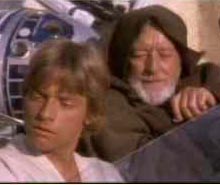
These are not the droids you're looking for.
Maybe this is the wrong Empire, though. Instead of Darth Vader, maybe the analogue is Nero. Rome is burning. Hand that man a fiddle.
Wednesday, January 10, 2007
Senator Frankensolo, I Presume?
In 1977 there was a new movie called Star Wars. Some people saw it, and some toys were made. I was seven years old, and this movie (and its sequels) would rule my life for the next seven years--to the extent that one of the first things I ever wrote was a one-page Star Wars parody called Star Bores. Hammer, Jam, and I expanded that to an entire trilogy of scripts, which we then performed and recorded on audio cassette. They were silly, sophomoric, and obscene. Sophisticated wits, we were not. Enthusiastic, we were. Speaking like Yoda, I am.
Before all that, though, we collected Star Wars action figures. In the beginning there were only eight: Luke Skywalker, Princess Leia, Han Solo, Chewbacca, C3PO, R2-D2, Obi-Wan Kenobi, Darth Vader, and the Stormtrooper. The first time we went to the grocery store after seeing the movie we saw a spinning rack with these toys hanging on them. Jam and I goggled. We had models of our heroes (and the villains) within our reach, standing heroically in plastic bubbles glued to cardboard tags. We begged, and we were allowed two each. They were 99 cents apiece, so our parents probably thought that was a cheap way out of a bunch of whining.
Jam took home Darth Vader and Chewbacca (I think) that first night. I got Han Solo and the Stormtrooper. Han was my guy from the beginning (more on my identification with secondary heroes in a later post), and I've been a fan of Harrison Ford for almost thirty years because of it.
Somewhere along the line I lost my Han figure. Maybe he was stolen. I don't know, but I wanted to replace him, so I went to the store and got another.
Han had changed.

<- Old Han / New (Frankenstein) Han ->
While the original figure didn't look much like Harrison Ford, it at least looked like a person. Between the purchase of my first Han and my second, Mattel changed the mold for Han's head, and the new one looked like Frankenstein's monster. Collectors now call them "Small Head" and "Big Head," but to me the shape was more significant than the size. The new head was kind of like an inverted triangle, with a bulbous forehead and a pointy chin.
Now, much of that is just background to this post. The truth is, this afternoon my boss had MPR playing while we worked, and I heard the voice of Norm Coleman. I couldn't stand him when he was the Democratic mayor of St. Paul. I had less regard for him when he prostituted himself to the Republicans when the Elephant party had power, and now that he's a senator I can only lament how poorly he measures up to the man he replaced.
The snarky part of me noted how dopey Coleman looks, and I could post his plastic surgery pictures, but I won't. He does look dopey to me, though. He looks to me like he's the face model for the "Big Head" Han Solo.
 Sorry, Jam. I'd like to show off my 733t skillz on Photoshop, but my skills are pure ghetto. I can't do you proud.
Before all that, though, we collected Star Wars action figures. In the beginning there were only eight: Luke Skywalker, Princess Leia, Han Solo, Chewbacca, C3PO, R2-D2, Obi-Wan Kenobi, Darth Vader, and the Stormtrooper. The first time we went to the grocery store after seeing the movie we saw a spinning rack with these toys hanging on them. Jam and I goggled. We had models of our heroes (and the villains) within our reach, standing heroically in plastic bubbles glued to cardboard tags. We begged, and we were allowed two each. They were 99 cents apiece, so our parents probably thought that was a cheap way out of a bunch of whining.
Jam took home Darth Vader and Chewbacca (I think) that first night. I got Han Solo and the Stormtrooper. Han was my guy from the beginning (more on my identification with secondary heroes in a later post), and I've been a fan of Harrison Ford for almost thirty years because of it.
Somewhere along the line I lost my Han figure. Maybe he was stolen. I don't know, but I wanted to replace him, so I went to the store and got another.
Han had changed.


<- Old Han / New (Frankenstein) Han ->
While the original figure didn't look much like Harrison Ford, it at least looked like a person. Between the purchase of my first Han and my second, Mattel changed the mold for Han's head, and the new one looked like Frankenstein's monster. Collectors now call them "Small Head" and "Big Head," but to me the shape was more significant than the size. The new head was kind of like an inverted triangle, with a bulbous forehead and a pointy chin.
Now, much of that is just background to this post. The truth is, this afternoon my boss had MPR playing while we worked, and I heard the voice of Norm Coleman. I couldn't stand him when he was the Democratic mayor of St. Paul. I had less regard for him when he prostituted himself to the Republicans when the Elephant party had power, and now that he's a senator I can only lament how poorly he measures up to the man he replaced.
The snarky part of me noted how dopey Coleman looks, and I could post his plastic surgery pictures, but I won't. He does look dopey to me, though. He looks to me like he's the face model for the "Big Head" Han Solo.
Sorry, Jam. I'd like to show off my 733t skillz on Photoshop, but my skills are pure ghetto. I can't do you proud.
Tuesday, January 09, 2007
Ignorance by Milan Kundera
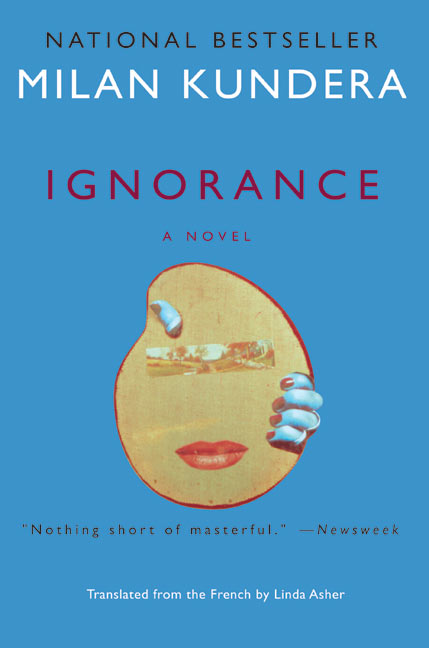
I don't envy the position Milan Kundera has put himself in. That is, I'd love to have written two brilliant novels in the 1980s, especially two as amazing as The Unbearable Lightness of Being and The Book of Laughter and Forgetting, but I'd hate to try to live up to either of those. By most accounts, Kundera hasn't come close to matching either one, and I'll have to add Ignorance to the list of novels that don't stack up.
That said, I also think Ignorance is a great novel. It doesn't have the sweeping, universal feel of Laughter, and it isn't as poignant or as eye-opening as Lightness, but it still has all of the incredible Kundera insights and ideas I've come to expect. Just because this book isn't quite as good as two of the best novels I've ever read doesn't mean it's bad. Ignorance is still leaps beyond most writers.
For this book Kundera has taken exile as a theme, and derives the title from various translations of the idea of nostalgia. This is a simple plot, and doesn't incorporate any startling devices, but the narrative is full of Wisdom. It's a good read, and it's short. Too short, I think. Because I want more. Well, I haven't read The Joke yet.
Monday, January 08, 2007
Freaks in Late Modernist American Culture by Nancy Bombaci
 The second of the extremely special-interest books Michele got me for Christmas. This one's only partly dedicated to Nathanael West, but it's still really interesting. Bombaci deals with West mostly as a Jew, a hereditary outsider. She makes the case for West's protagonists to be seen as flâneurs--people who wander and observe. She takes the freak as a a stand-in for the Jew, and draws historical connections between the two. Interesting stuff, but if her point is that West saw himself and his protagonists as outsiders, then she isn't saying much. The way I see it, most artists see themselves as outsiders. That's why we feel the need to comment. If we were content or felt like we belonged we'd be accountants or something.
I need to read more of these artists. I just got a Carson McCullers book, and I'm interested in Tod Browning's movies. I have no idea about Djuna Barnes. I'll have to look further into her. Then the rest of the book will mean more to me.
Sunday, January 07, 2007
American Superrealism by Jonathan Veitch
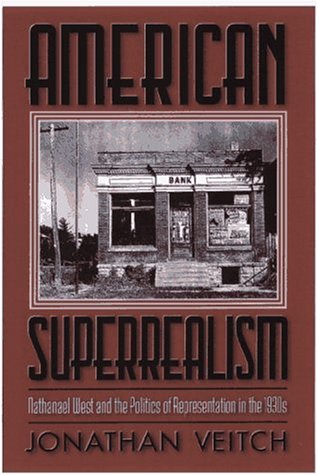
The whole title of this book is American Superrealism: Nathanael West and the Politics of Representation in the 1930s. This is the first of two books Michele got me for Christmas, and I love it. It triggered all kinds of ideas. Sure, it's a little academic for a gift, but I have no complaints. I did ask for it, after all.
A year and a half ago I was urged to read West, and he's quickly become an obsession for me. I've read his four major works, investigated the screenplays he wrote, and coveted more complete West collections so I can get into what made this guy tick. There aren't many authors who offer this level of study: a brilliant but limited body of work, enough critical and biographical interest to fill in some of the background, and connections with some of his era's better-known figures in a number of genres (William Carlos Williams, F. Scott Fitzgerald, Dashiell Hammett, S. J. Perelman) that lead to a more personal understanding of the artist. Plus, since he isn't as well-known as comparable writers, like Flannery O'Connor or even Kurt Vonnegut, the insights I gain from studying him have the possibility of freshness. I like that.
Veitch's work is interesting in that it places West's work in two contexts: the socio-political and the artistic. He doesn't waste a lot of time on the "self-loathing Jew" thing, an approach that I think is overdone and not very helpful. Instead, Veitch concentrates on West's affinity for, and differences with, both the Communist Party and the European Surrealist art movement. It's a fascinating study that helps to explain West's subject matter (proto-Communist), and his treatment of it (derived from Surrealism). For his era, West is a one-of-a-kind American writer, which is obvious when reading him, but confirmed by this study.
Not too many people will be interested in all of this book, but I thought it was a fascinating read.
Saturday, January 06, 2007
As 2007 Begins
There will be no New Year's resolutions in this space. I don't do those, because I figure if there's something I should do, I should do it when it occurs to me, and not wait for some arbitrary date to make some kind of statement. I can't live for statements--they don't motivate me.
Today, a week into the new year, we're celebrating Christmas. Again. I've lost track of how many of these we've done, and we missed one of them. I don't mind them, because Christmas, to me, has always been a time to reconnect with people. So we connect. I have to admit that this holiday has perplexed me a little over the last twenty years or so.
The religious aspect of Christmas has never held any influence on me, and the commercial aspect disgusts me, but there's people. And food. Relatives of any number of degrees of distance and big heaps of roasted meat. And potatoes. But I digress.
Today we're gathering with Michele's half-siblings and their entourages at the MIL/FIL Manor. When I say "entourages," I mean spouses and offspring. In addition to the Demon Nephew there will be five other imps and gremlins under the age of ten. Last weekend there were more, but six of them ought to generate enough chaos and noise to scare Manuel Noriega out of whatever palace he's in now.
The only downside to all of this celebrating is that I have some stories that are really screaming at me now. A novel and a couple of screenplays produce great ideas by the dozens every day, and I only have so much time to commit them to paper (or pixels, as the case may be). I fret that though I'm working, I don't have anything circulating except my second screenplay, Running the Asylum, about which I won't hear anything for almost a month. I dart back and forth between my novel and one of the screenplays all day, and my progress with each is stunted for it. I'm most inspired on the novel right now, but the screenplay is closer to a completed draft, so I feel torn, but I may have stumbled on a bit of relief.
I'm reading Kundera again (Ignorance this time), and that made me start thinking of my novel in sections. While I arranged those it occurred to me that the first section might make a good short story with a few judicial adjustments. So I'm pounding on that first section, and the characters, the settings, and the themes are all lining up really well. I never have to worry about plot, because that usually takes care of itself for me. I love where this one's going, and I might start pestering people to take a look at it in the next couple of weeks.
So while I don't do resolutions at New Year's, I am finding my creative life taking a more significant direction. The lethargy and despair of the last eight months seems to be lifting, and the stories demand to be told.
So far, 2007 feels pretty good.
Thursday, January 04, 2007
Lord of Chaos by Robert Jordan
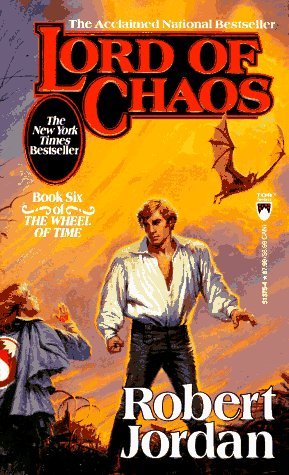 My reading life started with fantasy literature. At six I read The Lion, the Witch, and the Wardrobe, and at seven I read The Hobbit. When I was nine I started The Lord of the Rings, and in my early teens I moved on to the Dragonlance novels, Dennis L. McKiernan, and anything else with cool cover art involving swords, magic, elves, or ogres.
During my first few years in the navy I spent a lot of time reading -- about five books a week. It was then that I made my shift toward literary fiction, but I still mostly read fantasy. When Robert Jordan's first Wheel of Time book, The Eye of the World, came out I snatched it up and read it quickly. It was great. Broad, detailed, and fresh. Well-executed. Then I read the second, third, and fourth books as they were released.
At intervals of about a year and a half.
I got tired of waiting for each new book, and I was firmly in the grip of "real" literature in my mid-twenties, so I dropped the series. Twelve years or so passed, and this last summer I thought I'd try Jordan again. The situation was right: I always read something light (read: genre fiction) right before bed to rest my mind, and Jordan has finished eleven of his twelve novels in this series, so there won't be too much waiting in between (unless Jordan dies before he finishes number twelve, which is a possibility). So I started at the beginning again.
Lord of Chaos is book number six, and I've reached the midpoint of this series with mixed emotions. Fantasy literature operates with a different set of requirements from literary fiction, and one of those differences is in purpose. The fantasy author is creating an escapist work, building a new reality for the reader to inhabit, and that habitation rivals character development and plot in importance to the genre. In this respect, Robert Jordan has no equal. The world he has created in The Wheel of Time is complete, tactile, and vivid. After six novels (and about 4,000 published pages) I've spent more time with Rand al'Thor than I have with my friends in the last half year.
The first few books in this series moved well. It seemed each event was necessary, compelling, and served the plot. That becomes less the case with each book. It feels like the need to go twelve volumes has overtaken Jordan's obligation, in Kurt Vonnegut's words, to "start as late as possible and end as early as possible." I hate to imagine what would happen to this story if it were rewritten for the sake of plot-coherence. It might become a trilogy.
I feel like I've invested too much time to give up on this now, but I'm only halfway done. And I can't shake the feeling that Jordan's dragging his feet. He has so many story arcs going we go hundreds of pages without reading about central characters. It's crazy.
So, I don't know. I guess I'll keep going, but I hope in the end I don't wind up like Ralphie in A Christmas Story when he decodes the message after getting his ring: "A commercial? A crummy commercial? Son of a bitch!"
Wednesday, January 03, 2007
Portnoy's Complaint by Philip Roth
 Philip Roth is a sneaky man. Every time I read one of his stories I spend most of the time thinking "this is the time he really doesn't have anything to say--he's just dragging me along on this obscene journey merely to create a convincing perverted reality." Then I get to the end, and I'm wrong. Again.
Roth has two fixations: sex and Jewishness. These are also the fixations of his protagonist, Alexander Portnoy. While Roth and Portnoy explore sex and Jewishness they lay the foundation for a serious comment on self--or, rather, Self. As amusing as the novel is, its real strength is in constructing such a powerful statement from the petty observations of a self-absorbed narrator.
Funny stuff if you're willing to interpret Portnoy charitably. If not, this will just aggravate you.
Subscribe to:
Posts (Atom)